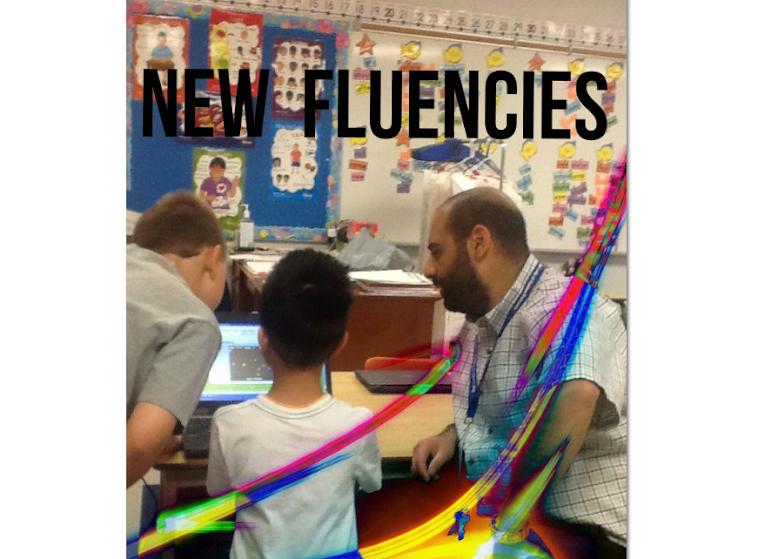
Monday, October 21, 2019

Esports with Primary Students - Part 1: Jumping In

A few months ago I dove into esports when I took a course called "Build a school to career pipeline with esports and gaming concepts" through the Microsoft Educator Community. It was a good course - quite informative with respect to what esports is, what it looks like in an educational setting, and how to get started (high school and above). My only issue with the course was that it didn't get into esports or gaming concepts with younger students. Having integrated video games into the learning of primary students in the past, I was surprised that there wasn't much on that in the course.

In 2012 I learned about a teacher in the UK who was using video games with students to help them improve their writing. David Andrews was integrating the use of technology (iPads) and video games to help engage his students in the writing process and to help them improve their writing. At the time, I thought that I could have used what David was doing with the last class I taught - a large group of boys who disliked writing very much. Based on his results and consultations with him, I decided to try implement some of what what he had done to help my students along with their writing process and skills. I ended up writing a series of blog posts about the experience. Feel free to check them out here: part #1, part #2, and part #3.

Seven years later and I find myself interested and intrigued with competitive and organized video gaming and how it can be integrated into the curriculum - especially with primary students. One of the reasons that esports is so popular is because a lot of kids play video games - and are good at them. From a global perspective, millions of people around the world tune in to esports events that are streamed online. The fact that "27 Million people watched the League of Legends Championship in 2017 [*more than Game 7 of the World Series (23.5 million) and the final game of the NBA Finals (18 million)]." is mind blowing. "Projections are that over 589 million people will watch esports by 2020.".

Based on the growing popularity of esports, how much kids love to play video games (generally speaking), my enjoyment of video games, and the opportunity to increase student engagement and achievement (academic, social, and emotional) by integrating esports into the curriculum, I decided that I wanted to bring it into my classroom. I started by looking online to see what I could find regarding esports with primary students. I didn't find anything. I went to Twitter next and I found the #esportsedu community which is strong and growing larger each day. I was looking for a model or a template that would help me integrate esports into my grade 3 classroom and hoped that I would find that within the #esportsedu community but I didn't find any such thing. I did find people like @chomoojoo, Mike Washburn, and Steve Isaacs who have been helpful and supportive. So much so that I decided to blaze my own trail based on my interactions with them.

After communicating with them, and thinking about how I wanted to get started, I decided that I wanted to find a game that would be competitive, accessible to my students (free, online, and easily played on a chromebook), and be connected to the curriculum. I went to the Cool Math Games website and started searching. I found Moto X3M - a cool motorcycle game that involves passing levels. At the end of each level, the students are informed how long it took them to complete the level. BINGO! I found a game I could use. Let me explain.


I introduced the idea of esports to the students. They were interested, actually they were pretty excited that they were going to get to play video games in class. I introduced them to the game and told them that their goal was to complete the first level as fast as possible and that I would give all of them 15 minutes to practice. In order to make it easy for the students to get to the game, I grabbed the link and put it in our D2L class site for easy access.

The competition would involve three rounds. In the first round, all the students would have the opportunity to compete. The top ten finishers would move on to the second round. In the second round, the top five finishers would move on to the third round. In the third round the first, second, and third place finishers would be identified.

After the first round, each student had to read their number to me. Up to this point we had only worked with whole numbers - this would be a great opportunity to talk about the decimal and the continue our talk about place value. After each round the students were responsible for comparing and ordering the finish times, which connects with the work we had just formally finished up with respect to Number Sense and Numeration. The opportunity to spiral our mathematics is welcome as it provides the students with points of reference with which they can refer to as they continue to learn. In this instance they could make connections to what they had already learned in math and moving forward they can look back on this esports activity to connect to the 'new' math they will be learning in the future.

Take a look at the data we collected. I recorded the times as they were brought to my attention. The students had to work to compare and order the times. They asked me to highlight certain times but didn't ask me to create a new chart to order them.


The students that were eliminated from the competition worked on improving their times but would stop and work with the rest of the students to compare and order times after each round. At the end of this competition we talked about the experience and whether they would like to do it again. All of the students indicated that they wanted to participate in esports and even had suggestions on what games we could use to compete.

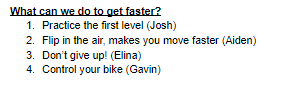
This was a really fun experience. Although the math was a bit challenging, it didn't seem to scare any of the students away. What I was seeing and hearing as they were comparing and ordering the times was great formative assessment data for me. I could see which students were able to do the activity with ease, who struggled, and everything in between. This activity also allowed me to take a look at some of the learning skills like initiative, collaboration, and organization. After all was said and done we took time to reflect on what the students could do to improve their times with respect to this game. Here were their responses:
In terms of next steps I would like to continue to find games that will allow students to compete and that I can connect to the curriculum. At first sight and thought, I can make quick connections between esports and the Language curriculum. I also see how these types of activities can benefit students with respect to "assessment AS learning" experiences. The Global Competencies and Catholic Graduate expectations need to be considered as well as I move forward with this in a more organized fashion. I would also like to move the esports out of classroom time and into recess time as an extra curricular activity. I think it would be a great option for the students who like to play video games and compete. I am also interested in using a console gaming system like a PS3 or Xbox where students can compete 'head to head' in true tournament fashion with traditional sports games like hockey and soccer. 

I think that my students and I did a pretty good job for our first esport activity. With no model or template I took what I had learned about esports so far and put it into action in order to get the ball rolling and start my learning journey and how I can help my students improve their achievement in a number of different areas. 

I would love to hear from you. If you have any questions or comments, please feel free to leave them in the comments. 


Monday, June 10, 2019

Success is Relative

When I found out that I was transferring to the school I am currently at, I was told that my skill set (integration of technology and building relationships) was going to be a really good thing for the students at the school. With the end of the school year approaching fast, I have been reflecting on and processing what I was told.


I have always been a firm believer in meeting my students where they are at and helping them build and grow based on the skills and attitudes they demonstrate to me. No two classes are the same so why would I expect to engage in the same "recipe" I may have used with the last class? Every group helps me set a customized path for them and I have to say that I am really proud of where my students started this year and where they will end. Let me explain.

The school I work at has a large population of newcomers to Canada. In my classroom alone the majority of the class is made up of students that have not been in Canada very long. Just today I was looking around the room as the students were working and was fascinated with the cultural diversity. There are students in my class from Sudan, Eritrea, Ethiopia, and Isreal, to name a few locations. English is not their first language and as they are learning to speak, read, and write English they have been open to building positive relationships with me and their classmates and have been open to the use of technology to learn and demonstrate their learning.


Some of the things I have introduced them to has blown their minds. 3D printing, virtual reality, coding, Google Drive, and the use of audio/video are examples of things I have introduced them to for the experience and for them to consider as options to help them with their learning and their demonstration of learning.

The introduction and integration of the technology I have mentioned above has come differently than any other class I have worked with. My experience at this school has required me to teach in a way that I have never experienced before. It's hard to explain the shift but it was a necessary one. The student make up of the class in front of me is largely made up of ELLs, students with special needs, and "neurotypical" students. I have worked in a variety of schools in a variety of locations and none of my prior experiences come close to what I have been experiencing this school year. Having said that, it has been a special year and has been a good change for me for a variety of reasons.


My focus with this class was to build relationships and learn how to "reach" them so they would learn and achieve. The integration of tech took a backseat because It didn't feel like it was appropriate to engage in the way I have done so in the past. As I learned how to teach the students in my class this year, and built good relationships with them, I started to feel more comfortable taking risks with my learning which led me to start introducing them to learning that would require them to take risks. Together, we have been able to engage in some pretty awesome stuff. Those experiences have only strengthened relationships and led to more risk taking with our learning.


I had a moment late last week which has led me to this blog post. As I was conferencing with a few students, I looked up and saw the following:

1) students talking about the Father's Day gifts that the 3D printer was printing,
2) students working on a writing activity using Google Slides,
3) students discussing the YouTube video that we would create for our Math coach,
4) students speaking in English and their home languages as they worked on the items I mentioned above.


Success is relative. It looks different depending on your circumstances. I can say, with full confidence, that this group has found success this school year.


Tuesday, April 16, 2019

Lend a Helping Hand: Kids helping other Kids

I became interested in 3D printing about 6 years ago when one of my grade 2 students told me about an idea she had. She was writing about and drawing pictures of a Leperchaun trap. She said that she could see it in her mind. She wanted to create a prototype that she could hold in her hands. It was that conversation that got me thinking about design and creation using 3 dimensional technology.

Two years after that conversation I had a 3D printer in my grade 4 classroom. It tuned out to be an amazing year of learning! We documented our journey - you can read all about it at https://21c3d.blogspot.com/. I remember hearing about 3D printed prosthetics back then and I tried to connect with people so that my students could help out but we had no luck. I thought it would be a great social justice project for my students but it wasn't meant to be.

Fast forward to this school year (three years later) where I stumbled upon Valerie Perez's twitter account (@3rdgrade_STEAM) which led me to "Enabling the Furture" (@Enablethefuture): a global network of volunteers using 3D printers to provide people with prosthetic hands. I checked the website out and learned about the great work that Enabling the Future is doing. I brought it to my student's attention and told them what my students and I tried to do years ago. They thought it would be a great learning experience to try and print a test prosthetic so we started our learning journey.

One of the first things we had to do is figure out which hand to print. Once we made our decision, I started looking for the files to print so we could start putting the hand together. I had difficulty finding files that were compatible with our printer so I reached out to Doug Braden (Chief Technology Officer at Inksmith) to ask for help - and he did!! After a couple of days of printing we were happy to share with our twitter followers.


The day after the above tweet, we had the hand assembled and my students wanted to share a little bit about our journey.


After pushing this out we got some responses. All of them were complementary but one of them really got me thinking. I was asked how I am convincing people that primary students did this?


My class and I are doing this together. Parts of the project are more appropriate for me to deal with rather than the students. Having said that, I don't feel that I need to convince anyone of anything. I talked a little bit about this on a podcast, you can hear my response to the question here:


The work we are doing is much deeper than printing parts and putting them together. Of course, that part of this project is necessary but it isn't where I would like to spend our focus. My hope is that the students remember our work as a service to others, the importance of learning (especially the hard parts that we have to overcome), and that they don't need to wait to make a difference in this world. Using the technology we have at our hands, we can help other kids and hopefully lend them a hand.


Thursday, November 8, 2018

micro:bit, macro:thanks


Matthew Griffin, Operations Manager at Kids Code Jeunesse (KCJ), was in our classroom yesterday. He came to teach us about the micro:bit - a hands on tool that makes teaching code fun, easy, and accessible. KCJ is bringing micro:bits and a FREE micro:bits workshop to schools and educators across Canada. I read about this initiative on Twitter through my PLN - big thanks to Doug Braden (@DugBraden) and Michael Leonard (@mfleonard23) in particular. I applied for a workshop and was fortunate enough to get a spot.


Matthew did a great job of working with the students and presenting the material to them at their level. The students were partnered up and each group of two had a Chromebook. After an unplugged activity, the students were introduced to the block coding site where they would start putting instructions together to be tested out on the emulator and then downloaded to a micro:bit. This experience was a great opportunity to practice showing grit (persistence + resilience) as the students failed forward in their quest to program the micro:bits.


Aside from my students having a great time learning how to code the micro:bit, I have to say that this was excellent professional learning for me. Since Matthew was directly teaching the students, I had the same learning opportunity as them and I got to walk around the room and help students as well as troubleshoot some of their issues. Rather than leaving the classroom to attend a workshop on my own, it was embedded in my class with my kids so we could all learn together. This has turned out to be quite beneficial for me because I was learning it with them and because it came naturally to some of them - more than it did for me! Now I have "experts" in the room who can support their classmates. This is a big win for me and for them.


When school started this morning there were a handful of students asking when they would get to work with the micro:bits again. They are excited and want to engage with the technology to learn more about how it works and the things they can do with it. I was provided with some resources for next steps and will certainly be using them to help the students who are keen about continuing their learning around coding.

If you are interested in trying this out, head over to https://kidscodejeunesse.org/microbit.html and apply to have someone from @kidscoding come to your school to work with you and your students. You won't regret it!


Saturday, November 3, 2018

The Spark


Image result for spark


A couple of weeks ago I emailed all the teachers at my school and asked if anyone had any interest in learning about 3D printing.

No one responded to the email. I was feeling low, but realized that we were in the middle of writing progress reports.

I decided that I would approach a few people and talk to them - face to face. Before I could get out of my classroom three staff members approached me about my email! I was feeling high again - ready to chat with and support teachers and students who want to bring their ideas to life with respect to their learning at school.

One of the grade 6 teachers decided to dive into 3D printing by allowing his students to spend some time playing with Tinkercad in order to familiarize themselves with the software they would be using. The next step involved providing them with an assignment to create a key-chain with specific dimensions. The teacher was a bit apprehensive but also quite excited about the process his students would enter into.

You can imagine how happy I was when two of his students came to my door late this week to ask if they could print their key-chains. They were excited to see the machine and how it worked. We loaded their stl files into Makerbot and hit print. They were mesmerized as the machine started to do its magic.

A few hours later they were holding their key-chains and amazed at how they had visualized what they wanted to create. They put their thoughts into action to get their ideas out of their heads - into a computer - and then finally into the palm of their hands.

The classroom teacher was full of excitement as he talked to his students about their key-chains. He talked to them about the success criteria attached to the assignment, asked them to reflect on it, and together we made notes about how the machine works and how to maximize what the technology can do and the connection to the design process.

I left school on Friday feeling good about the support I was able to provide the teacher and his students and look forward to what comes next with respect to their learning and bringing it to life with the 3D technology.

As I was pondering this blog post this morning, I received a message from one of the Grade 3 teachers asking about providing him support this coming week with the technology. Of course I said yes and can’t wait to see what his ideas are and how his students respond to the challenges that will be presented.


Sometimes, a spark is needed to get people to take a risk and try something new - something they are not comfortable/familiar with. When it comes to technology and its integration into the classroom I don’t necessarily need a spark, but I recognize that others do. These teachers have started their learning journey - I can’t wait to see and hear their students in action as they embark on the same risk taking that their teachers have undertaken.


Image result for spark

Saturday, September 22, 2018

I AM NOT a Math Person

As an elementary school teacher, one of the content areas I am responsible for teaching is Mathematics. If you allow me a moment to speak in a negative way, I will tell you the following:

I am not a "Math" person. 
I didn't enjoy learning it when I was young and 
I am resistant and generally scared of it as an adult.  

From a positive perspective, I know that I can teach it and that there are lots of resources to assist me in teaching it. What I stated above is how I feel when my back is against the wall and/or when I am at a Math workshop/pd surrounded by people who seem to know what they are doing when it comes to numeracy and how to teach it. 

When I was interviewing for the teaching position that I am currently in, I was asked by the Principal what I thought I had to work on from a professional perspective. My answer? Mathematics. I told him that I am frightened of it. It gets done and I am constantly learning but that it has always been an area of weakness. I am thankful that he didn't hold it against me! He told me that our school is provided with support in the area of mathematics and that I would get to be a part of that. I was up for the challenge and that time and I am still up to the challenge now. 

Fast forward to this past week when I had a chance to meet with the Numeracy Coach attached to my school. Ms. Dosman will be working with my students and I. In an email to myself and the other teachers involved she provided us with the focus of our first sessions of collaborative inquiry: what impact would daily number sense routines, and rich number tasks have on student flexibility and tool strategy selection? The email also asked us to consider where our students' greatest needs are in relation to our inquiry focus and an example question was provided:

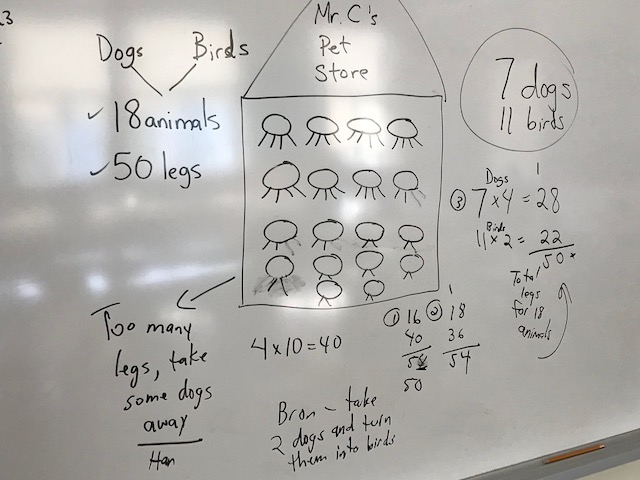
There are 18 animals in a pet store. Some are birds, and some are dogs. There are 50 legs in all. How many birds and how many dogs might there be? Show your thinking.

I decided to take the question and present it to my students.


Here is the email I sent Mrs. Dosman the morning after my students tried the problem:

Ok, so they didn't solve the problem completely. Some of the kids said they were going to work on it at home so we shall see what happens today. I am going to try something to see if it kickstarts them in a positive direction.It was nice to see some of the students step up and take a risk - many of the students didn't jump in. I had more success with the number string we did (dots). Hopefully when we start with the number string today they will feel more confident. We shall see!They needed prompting but I was careful not to provide too much as I didn't want to be the one doing all the work.They focused on the legs and then forgot that there had to be 18 animals. Will update you today if any more comes of it.

Here is what ended up happening when we addressed the problem again:


My message to Mrs. Dosman:

Ok, so I drew a picture for them. It was the pet store with 18 legless animals in it. We had a lot of fun and finally solved the problem. Some students wanted to eliminate animals from the store and some were saying that we would have birds and dogs with no legs!

I took some liberties the second time around with the question. They were able to solve the problem and I was able to gather important information about what my students were doing and not doing with this question. I ignored my lack of confidence with math and did my best to praise my students for taking risks and providing their thoughts and ideas. 

Shortly after the students worked on the animal/leg problem, Mrs. Dosman came into our class to do a pre task activity with the students. They were provided with three questions (progressing in difficulty from the first to the third question), a pencil and paper activity. They were allowed to use any strategy/tool (except calculators) to complete the questions but could not seek assistance from the teachers or their classmates. It was tough to not provide them with any ideas or direction but we had to see what they could do on their own. It was over an hour before the last student finished and we could gather the class to debrief. 

Mrs. Dosman working with one of the students.

By this point they had worked with me on the word problem twice and the pre task for an hour. I thought that they would not want to actively engage in something like this again any time soon but I was pleasantly surprised when one of the student asked a great question in class. It was pizza day and the student wanted to know how much it would cost to purchase an entire pizza! He had two slices but was wanting me. I (the non math person) felt an excited and asked the class if we could play around with his question. They said yes and wanted to get to the bottom of this!

Here is a photo of what ended up happening:


I told the students that I personally like to draw information from the problem. I then solicited their thoughts/ideas and we went from there. As you can see, we ended up talking about money, fractions, and skip counting. More students engaged in this problem than the last one and they seemed to be more at ease with the process. For me, this is such a gift. 

One of my goals for this school year is to look at mathematics as a new fluency. One that I can jump in and out of with a confidence around the ability to learn new things and be able to apply them in order to help my students with their learning and love of math. With Mrs. Dosman's coaching and my self directed PD, my hope is that 1) my students will become comfortable sharing their thoughts and ideas in math; 2)  they will willingly enter into working through problems like the ones above; 3) that they will acquire a variety of tools/strategies and know when and how to use them; and 4) a flexibility in their thinking when dealing with math problems. 

Friday, May 4, 2018

Jumping into Deep Learning

Last year my students and I participated in a twitter chat about New Pedagogies for Deep Learning during their annual global event. It was such a great experience that I made it a priority point to participate in this years event. As I kept my eyes open for information about this years conference, I stumbled across this tweet from our 21st Century Learning Consultant, Ferdinand Krauss:


Ferdinand's tweet encouraged students and teachers to participate in this years NPDL deep learning task. He also attached the task and other important information:


Thanks to Ferdinand, I had everything I needed to get started with my students. The prompt involved students to think about "What the world needs now" and to share their ideas to develop global competencies in our school/town/city/nation. The students started by taking a look at the UN Sustainable Goals website. We decided that each student would research one of the sustainable goals and then share their knowledge/new learning using 1 google slide. Once the students finished their slide, they would share it with me and I put them all together into a single slide show.


At this point we seemed ready and excited to share our preparation for the global discussion. As a class, we had accumulated information about the sustainable goals and looked forward to applying some of our knowledge to talk about what we think the world needs right now. We tweeted out our work and responded to people who were following the #npdlworldneeds tag on twitter. 

People were seeing our work and tweeting about it and connecting with us. Things started to feel "real" for the students and they had a 'global' audience that could could interact with.


We were especially fortunate to connect with two educators from our school board who were in attendance at the NPDL conference in Vancouver - Kelly Roberts (WCDSB Research Coordinator) and Richard Setler (VP at St. Kateri Tekawitha). They provided us with prompts to consider and and even recorded a video for us while they were at the conference.


We responded to their video by creating a quick one of our own...


Within a week of returning from Vancouver, Richard and Kelly connected with our class via Google Hangout to share their experience and to continue to prompt the students to think deeper and to work on using the NPDL competencies to analyze situations and problem solve. 


Shortly after this hangout Richard reached out to us with a wonderful opportunity to work with a grade 1/2 class at his school.


The students were more than happy to oblige.


This new connection with Ms. V and her grade 1/2 students is proving to be an excellent learning opportunity. The grade 4/5 students are happy to help out the primary students and are challenging themselves with the questions/prompts coming from Richard and Ms. V. The discussions have been deep - allowing students to think about their perspectives and then explain their thinking. Students are respectfully challenging each others thoughts/opinions while they decide what information they want to provide the grade 1/2 students with. 


Having gone back and forth over Twitter, we are now working on bringing the students face to face in a Google Hangout. 

We are scheduled to meet with Ms. V's class early next week. The students are really looking forward to it. As their classroom teacher, I am quite impressed with the effort they are putting into this activity as I observe them work through it. Thanks to Richard and Ms. V, I am provided with the opportunity to assess my students with respect to the skill sets known as the 6C's (see below). My assessment will help me determine where my students are at with respect to the competencies and what my next steps will be to help my students attain the skills needed to excel in our complex world. 

Screen shot taken from http://npdl.global/